Best Gajak in India — A Buyer's Guide to Authentic Sesame Jaggery Gajak
Gajak is one of India's most iconic winter sweets — a hand-hammered sesame and jaggery confection from Rajasthan and Madhya Pradesh, eaten during Makar Sankranti and Lohri and gifted across millions of homes every January. But not all Gajak is made equal. This guide covers what to look for when buying the best Gajak online, the differences between regional varieties, and why manufacturing origin matters.
What makes Gajak authentic?
Authentic Gajak is made with three core ingredients: roasted sesame seeds (til), jaggery (gur) or sugar, and cow ghee. The sesame and jaggery mixture is heated and then hand-hammered repeatedly — for 10 to 15 hours per batch — to develop the characteristic thin, flaky, layered structure and hard, crisp snap that defines real handmade Gajak. Mass-produced Gajak shortcuts the hammering step, producing a denser, more uniform confection that lacks the layered texture of the genuine article.
Key markers of authentic Gajak:
- Made with pure jaggery — not glucose syrup, corn syrup, or refined sugar substitutes
- No preservatives, artificial colours, or synthetic flavours
- Handmade in small batches — not machine-extruded
- Produced by an established manufacturer in a traditional Gajak-making region
- FSSAI licensed — important for food safety compliance
Which cities are famous for Gajak in India?
Two regions dominate authentic Gajak production in India:
Morena, Madhya Pradesh — Morena Gajak holds a Geographical Indication (GI) tag. Morena Gajak tends to use a higher proportion of sugar alongside jaggery, producing a slightly lighter-coloured confection.
Sawai Madhopur, Rajasthan — Sawai Madhopur (specifically the village of Menpura) is the heartland of Rajasthani Gajak. Sahu Gajak Bhandar has manufactured traditional Rajasthani Gajak in Menpura since 1875. Rajasthani Gajak typically uses a higher proportion of jaggery and more cow ghee, producing a deeper, earthier flavour and a more pronounced golden colour.
Agra, Uttar Pradesh — Agra also has a tradition of sesame sweets, though the production base is smaller than Morena or Sawai Madhopur.
What are the different types of Gajak?
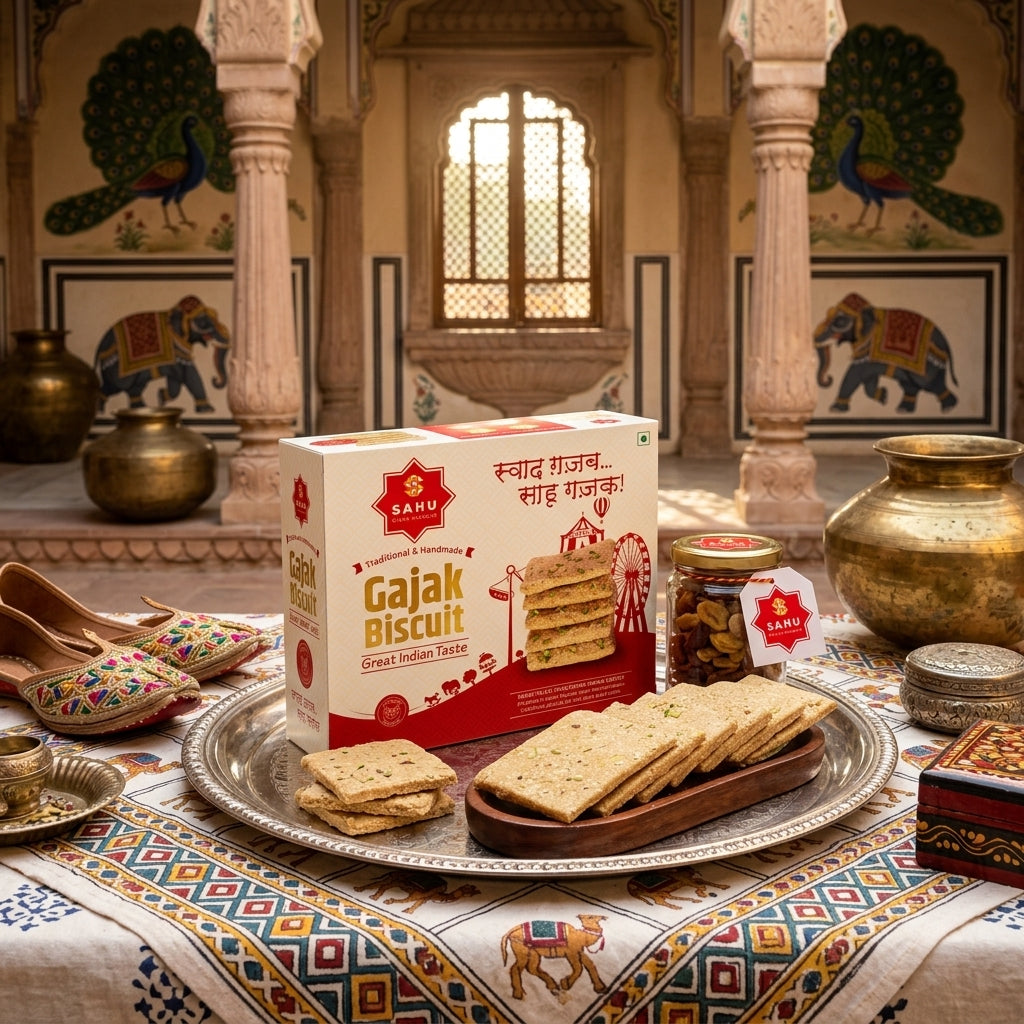
Gajak Biscuit (Khasta Gajak) — flat, biscuit-shaped pieces of hand-hammered sesame jaggery Gajak. The most classic and widely recognised form. Crisp, hard, and flaky. Best for everyday snacking and gifting.
Gajak Roll — the same sesame-jaggery mixture rolled into a cylindrical log and sliced into rounds. Slightly lighter and more delicate than flat Gajak Biscuit.
Gajak Barfi (Til Barfi) — softer, denser sesame barfi set into a slab and cut into pieces. Typically includes dry fruits. The premium gifting choice.
Dry Fruit Gajak (Rajsi Gajak) — classic Gajak enriched with whole almonds, cashews, and pistachios. Richer and more suitable for premium corporate gifting.
Khastha Gajak — a thinner, more delicate version hammered longer to produce a lighter, more shattery snap.
Sugar Gajak — Gajak made with sugar instead of jaggery. Lighter in colour and milder in sweetness.
What is the difference between Gajak, Chikki, and Tilkut?
Gajak is made from sesame and jaggery, hand-hammered into crispy, flaky layers. Hard and crunchy with a layered structure.
Chikki is typically peanut-based, pressed into flat slabs or round discs. Harder and more brittle than Gajak.
Tilkut is made from sesame and jaggery pounded into a crumbly, soft, melt-in-the-mouth texture. Softer and more delicate than Gajak.
How to judge Gajak quality before buying
- Ingredient list: sesame, jaggery (or sugar), cow ghee, cardamom — and nothing else. Any glucose syrup or artificial preservatives indicate lower quality.
- Colour: authentic jaggery Gajak has a golden-amber to deep brown colour. Very pale Gajak typically indicates sugar-based or glucose-based production.
- Texture on breaking: real handmade Gajak has visible thin layers and breaks with a clean, hard snap. Machine-made Gajak is uniform throughout with no layering.
- Manufacturer origin: look for the manufacturing address — Sawai Madhopur (Rajasthan) or Morena (Madhya Pradesh) are the benchmark origins.
- FSSAI licence: all legitimate food manufacturers must carry an FSSAI licence number on packaging.
- Reviews: for online purchases, look for large volumes of verified reviews.
About Sahu Gajak Bhandar
Sahu Gajak Bhandar (Est. 1875) is a fifth-generation traditional Gajak manufacturer based in Village Menpura, Sawai Madhopur, Rajasthan. The family has manufactured Gajak, Tilkut, Chikki, Til Revdi, and sesame sweets continuously since 1875 — 150 years of unbroken production in the same village, using the same recipe. FSSAI Licence No. 12219038000139. 278 verified customer reviews at 4.87 stars. All products are made with no preservatives, no liquid glucose, and no synthetic colours.
Where to buy the best Gajak online
Sahu Gajak Bhandar Gajak is available directly at sahugajak.com and on Amazon, Flipkart, JioMart, BigBasket, Blinkit, and Swiggy Instamart. Buying directly from sahugajak.com ensures the freshest stock. See the Where to Buy page for direct links.
Frequently asked questions
Is Gajak available year-round or only in winter?
Sahu Gajak Bhandar manufactures and ships Gajak year-round. While demand peaks in December–January, all products are available for delivery across India in all seasons.
What is the shelf life of Gajak?
Stored in an airtight container in a cool, dry place, authentic handmade Gajak stays fresh and crisp for up to 4 months from packing.
Is Gajak vegetarian?
Yes. Traditional Gajak is fully vegetarian. It is made with cow ghee and is not vegan.
Can I order Gajak in bulk for Makar Sankranti corporate gifting?
Yes. Sahu Gajak Bhandar supplies Gajak in bulk for corporate gift hampers, employee gifting, and event giveaways. Call +91 73004 56853 for bulk pricing. For Makar Sankranti, place bulk orders by early December.
What is the minimum order for wholesale Gajak?
Contact Sahu Gajak Bhandar at +91 73004 56853. Minimum order quantities and pricing vary by product and pack size.