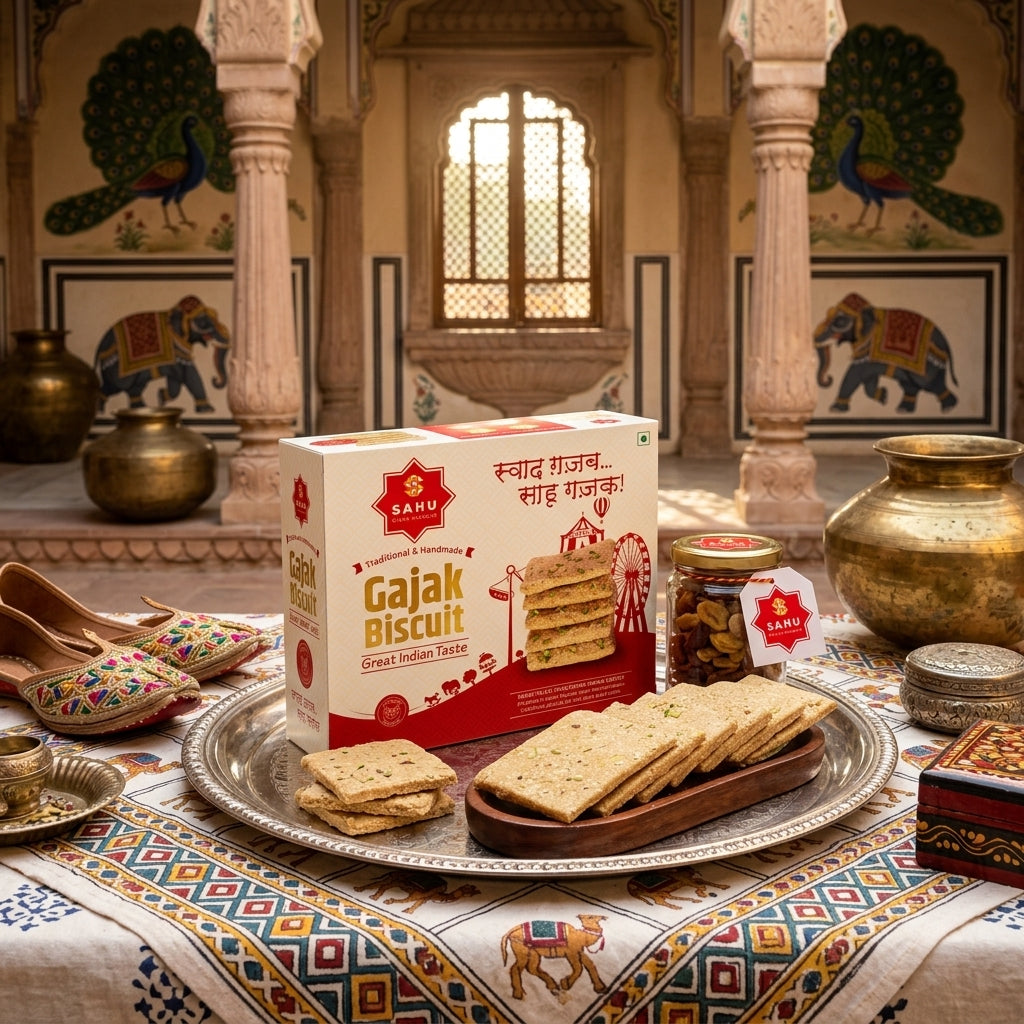

Gajak vs Chikki — What Is the Difference?
Gajak and Chikki are two of India's most popular traditional sweets, both made with jaggery and eaten during the winter season. They are frequently confused with each other, and many people use the terms interchangeably. They are not the same. This article explains the differences in ingredients, texture, preparation method, taste, and when each is eaten.
At a glance: Gajak vs Chikki
| Feature | Gajak | Chikki |
|---|---|---|
| Primary ingredient | Sesame seeds (til) | Peanuts (mungfali) |
| Sweetener | Jaggery (gur) or sugar | Jaggery (gur) |
| Fat used | Cow ghee | Usually none, sometimes ghee |
| Texture | Crisp, flaky, layered | Dense, crunchy, brittle |
| Key technique | Hammering for 10–15 hours | Mixing and pressing into slabs |
| Liquid glucose | Not used in authentic Gajak | Commonly used in commercial Chikki |
| Shelf life | 180 days (biscuit/roll) | 180 days |
| Origin | Rajasthan, Madhya Pradesh | Maharashtra (Lonavla region) |
| Festival association | Makar Sankranti, Lohri | Makar Sankranti, year-round |
Ingredients: the core difference
Gajak is sesame-based. The primary ingredient is white sesame seeds (til), which are roasted and then combined with melted jaggery and cow ghee. The sesame gives Gajak its distinctive earthy, slightly bitter, nutty flavour and its characteristic oil content — it is the natural oils from the sesame that create the flaky texture during the hammering process.
Chikki is peanut-based. The primary ingredient is roasted peanuts (mungfali / groundnuts), which are mixed with a melted jaggery syrup. Some variants use mixed nuts, sesame, or puffed rice, but the most common and original form is peanut Chikki.
Preparation: why Gajak takes so much longer
The preparation of traditional Gajak requires 10–15 hours of hand-hammering. The sesame-jaggery mixture is repeatedly worked by artisans using wooden mallets on a flat stone or metal surface. This hammering releases the natural oils from the sesame seeds and creates the distinctive layered, flaky texture that defines Gajak. No binding agent is needed if the process is done correctly.
Chikki is simpler to prepare. Roasted peanuts are folded into a melted jaggery syrup, spread flat, and cut into pieces while still warm. The process takes a few hours rather than most of a day. The result is a dense, uniform slab rather than the layered structure of Gajak.
This difference in preparation time is why authentic Gajak is harder to find and typically more expensive than Chikki.
Texture: flaky vs dense
Gajak is crisp and layered. When you break a piece of Gajak Biscuit or Gajak Roll, you can see and feel the thin, flaky layers created by the hammering process. It shatters and dissolves on the tongue rather than requiring chewing. The texture is dry rather than sticky.
Chikki is denser and more uniform. It has a satisfying crunch but does not have the same flaky layers. Peanut Chikki tends to be slightly stickier than Gajak because the peanut oils and the jaggery syrup produce a different consistency.
Taste
Gajak tastes of sesame and jaggery — nutty, slightly earthy, with a mild bitterness from the sesame that balances the sweetness. The cow ghee adds a faint richness. Jaggery Gajak has a deeper, slightly smoky flavour compared to Sugar Gajak, which is milder and lighter in colour.
Chikki tastes of peanut and jaggery — roasted, nutty, heavier and starchier. The peanut flavour is more prominent and the sweetness of the jaggery is less nuanced than in Gajak. Chikki is generally considered the sweeter, heavier of the two.
What about Sesame Chikki?
There is also a product called Sesame Chikki or Til Chikki, which uses sesame seeds as the base instead of peanuts. This product is closer to Gajak in ingredients but differs in preparation: Sesame Chikki is not hammered and does not develop the layered flaky texture of Gajak. It is pressed flat and cut like standard Chikki. Sesame Chikki is generally less expensive than Gajak because the hammering step is omitted.
At Sahu Gajak Bhandar, the Sesame Peanut Mix Gajak combines both sesame and peanuts in a Gajak-style preparation — a hybrid product that offers both textures.
Revdi: the third sesame sweet
Revdi (also spelled Rewari or Rewdi) is a third category of sesame sweet that is distinct from both Gajak and Chikki. Revdi is made by coating individual sesame seeds with a hardened jaggery or sugar syrup shell, producing a small, round candy. It is lighter and less dense than either Gajak or Chikki. Revdi is the sweet most commonly scattered as an offering during Lohri bonfires in North India.
Which is better for gifting?
Both Gajak and Chikki have a shelf life of 180 days from packing and travel well. Gajak — particularly Dry Fruit Gajak and Gajak Barfi — is generally considered more premium for corporate gifting due to its complexity of preparation and the craftsmanship involved. Chikki is more affordable and familiar to a wider audience, making it a good choice for large-volume gifting where budget is a consideration.
Sahu Gajak Bhandar offers the full range — Gajak Biscuit, Gajak Roll, Dry Fruit Gajak, Peanut Chikki, Gol Chikki, Sesame Peanut Mix Gajak and Til Revdi — across multiple pack sizes. All products are FSSAI-certified (Lic. No. 12219038000139) and free from preservatives and liquid glucose. Available at sahugajak.com with pan-India delivery.