
The Art of Traditional Gajak Making: A 150-Year Legacy
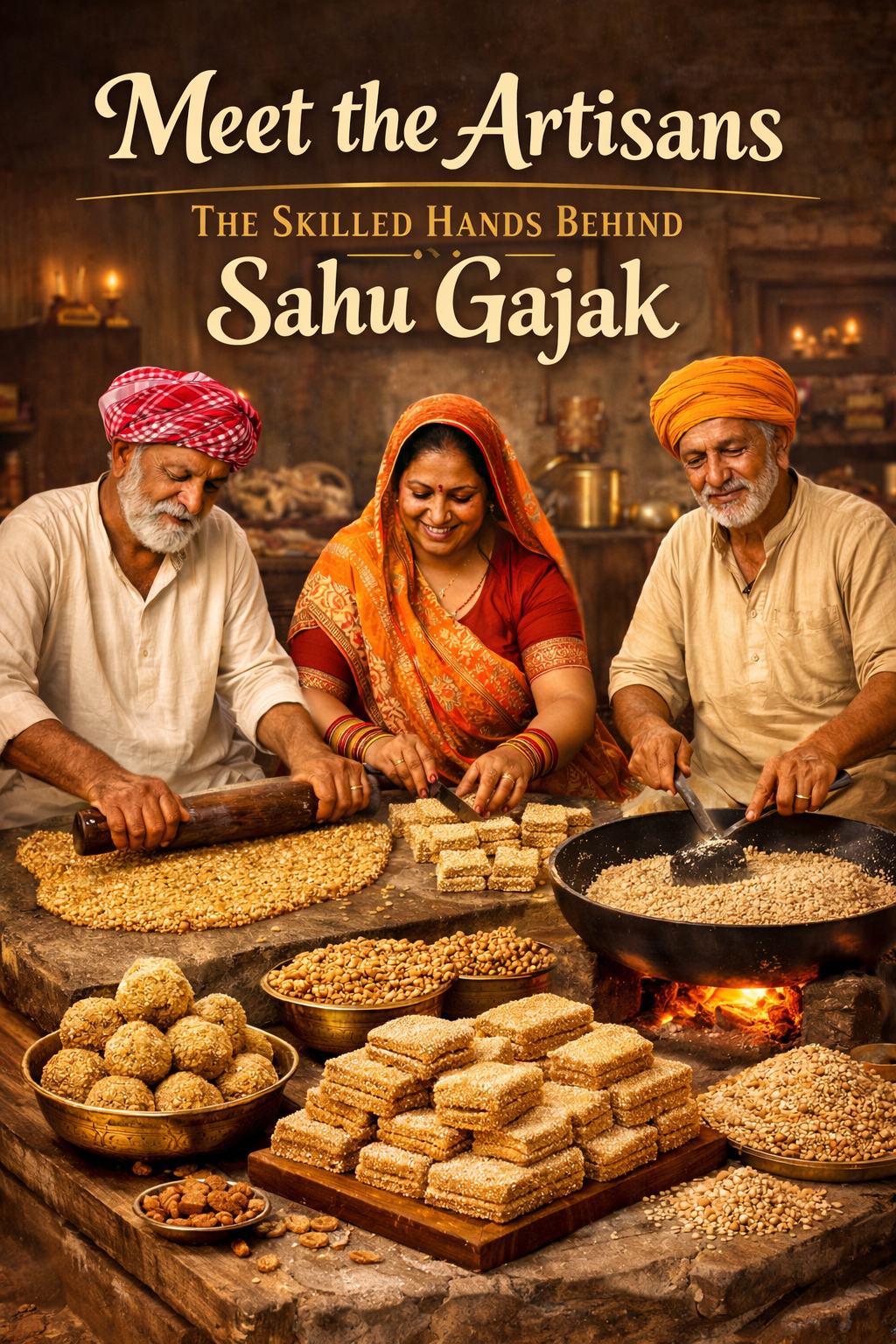
Making authentic Gajak is not a quick process. It never has been. At Sahu Gajak Bhandar's facility in Menpura, Sawai Madhopur, Rajasthan, a single batch of Gajak takes 10 to 15 hours of careful hand-hammering by skilled artisans — the same process, using the same recipe, that the Sahu family has followed since the 1870s. This article explains how traditional Gajak is made, why the process matters, and what distinguishes handcrafted Gajak from machine-produced alternatives.
What is Gajak?
Gajak is a traditional Indian sweet made from roasted sesame seeds (til) and jaggery (gur), hand-hammered into thin, crisp, flaky layers. It is one of the most iconic winter sweets of North India — a staple of Makar Sankranti and Lohri gifting, and a product that has been made in Rajasthan and the Morena region of Madhya Pradesh for generations. Sahu Gajak Bhandar specialises in the Rajasthani style, which uses cow ghee and a slower hammering technique than the Morena style.
The ingredients
Traditional Gajak uses four core ingredients: roasted sesame seeds (til), jaggery (gur), sugar, and cow ghee, with cardamom added for flavour. The quality of each ingredient directly affects the final product.
Sesame seeds used for Gajak are selected from the winter harvest — white sesame seeds with a naturally high oil content. Jaggery is sourced from sugarcane and chosen for its clean flavour and appropriate moisture content. Cow ghee is used both in the preparation process and as a flavour component. Sahu Gajak Bhandar uses no liquid glucose, no preservatives, and no artificial colours or flavours in any product.
The traditional preparation process
Step 1 — Roasting the sesame
Raw sesame seeds are dry-roasted in large pans over an open flame, stirred continuously to ensure even roasting without burning. Proper roasting is critical — under-roasted sesame produces flat flavour; over-roasted sesame turns bitter. The roasting stage releases the natural oils in the sesame seeds, which contribute to both flavour and the binding that holds the finished Gajak together.
Step 2 — Preparing the jaggery syrup
Jaggery and sugar are melted together with a small amount of cow ghee over controlled heat to produce a syrup at the precise consistency required for Gajak. The temperature and concentration of the syrup determine the final texture — too soft and the Gajak will not set; too hard and it becomes brittle without the characteristic flakiness.
Step 3 — Combining and initial setting
The roasted sesame seeds are combined with the hot jaggery syrup and mixed thoroughly. The mixture is then poured onto a greased surface and allowed to cool slightly to a workable temperature — hot enough to remain pliable but cool enough to handle.
Step 4 — Hand-hammering
This is the defining step of traditional Gajak making, and the one that cannot be replicated by machine. Skilled artisans fold and repeatedly hammer the sesame-jaggery mass using wooden mallets, working the mixture for 10 to 15 hours. Each hammering cycle stretches the mixture, then folds it back on itself — gradually developing the thin, layered, flaky structure that is the hallmark of authentic Gajak.
The hammering also aerates the mixture slightly and distributes the sesame oil evenly throughout, producing a more consistent flavour and a lighter texture than machine-pressed Gajak. Machine production can complete this step in minutes — but the resulting product has a denser, more uniform texture that lacks the layers of handmade Gajak.
Step 5 — Shaping and cutting
Once the hammering is complete, the Gajak is rolled or pressed to the desired thickness and cut into the final shape — flat biscuit pieces for Gajak Biscuit, cylindrical logs for Gajak Roll, or thick slabs for Khastha Gajak. Dry Fruit Gajak has almonds, cashews, and pistachios folded in at this stage.
Step 6 — Cooling and packing
Finished Gajak pieces are cooled completely to allow them to set firm before being packed in airtight sealed packaging. Proper cooling and airtight packaging are essential — moisture is Gajak's main enemy, causing it to soften and lose its characteristic crunch.
Why small batches matter
Sahu Gajak Bhandar prepares Gajak in small batches — enough to maintain quality control at every stage, adjust for seasonal variation in ingredients, and ensure consistent texture across every piece. The quality of sesame seeds varies between harvests; jaggery moisture content changes with the season. Small-batch preparation allows these variables to be managed by hand, batch by batch.
Six generations, one recipe
The Sahu family has been making Gajak in Menpura, Sawai Madhopur since the 1870s. The recipe has not changed. The preparation method has not changed. The artisans who make the Gajak learn the process through direct apprenticeship — watching, practising, and developing the feel for when the jaggery syrup is ready, when the sesame is properly roasted, and when the hammering has produced the right layer structure. This kind of knowledge cannot be written in a recipe card; it is carried in experience.
Our Gajak range
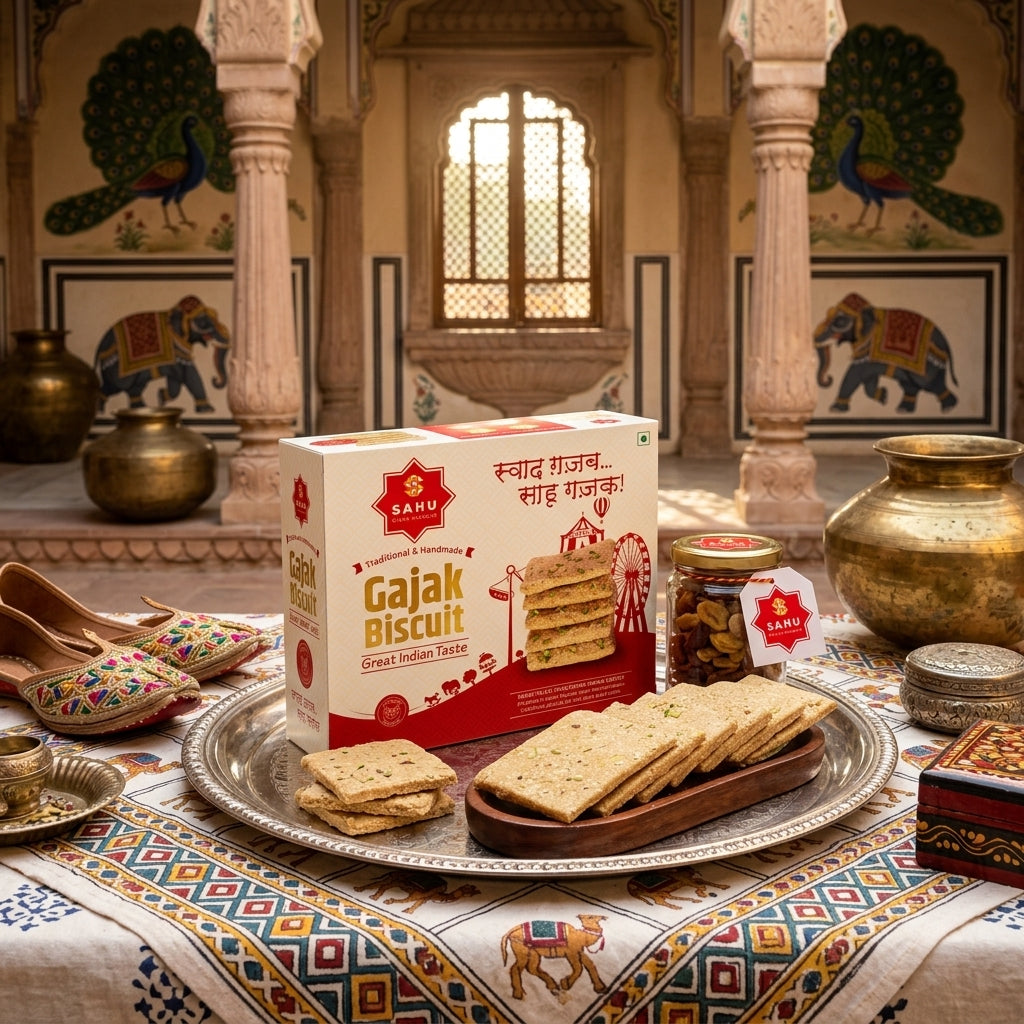
Sahu Gajak Bhandar makes several varieties of traditional Gajak, all using the same core process: Gajak Biscuit, Gajak Roll, Gajak Barfi, Khastha Gajak, and Dry Fruit Gajak — available in multiple sizes, freshly packed and delivered across India. We also make Tilkut, Til Revdi and Rewari, and Peanut Chikki using the same traditional methods.