
What is Gajak? A Complete Guide to India's Most Iconic Winter Sweet
If you have ever received a crispy, flaky sesame sweet during Makar Sankranti or Lohri and wondered what it was — that was almost certainly Gajak. One of India's oldest and most iconic winter sweets, Gajak is made from roasted sesame seeds and jaggery, hand-hammered into thin, crisp layers. This guide answers every common question about Gajak — what it is, where it comes from, how it is made, the different varieties, and how to identify authentic Gajak.
What is Gajak?
Gajak (also spelled Gachak, Gazak, Gajjak, or Gachak) is a traditional Indian confection made from roasted sesame seeds (til) and jaggery (gur), combined with sugar and cow ghee, and repeatedly hand-hammered into thin, crisp, flaky layers. It is one of the most representative winter sweets of North India and is especially associated with the states of Rajasthan and Madhya Pradesh.
The word Gajak is derived from the Hindi-Urdu tradition of naming sweets by their preparation method or primary ingredient. The defining characteristic of Gajak is its texture — hard and snappy on the outside, with thin layered sheets of sesame visible in the cross-section, produced by the repeated folding and hammering of the hot mixture during preparation.
Where does Gajak come from?
Gajak has two principal regional origins in India: Morena in Madhya Pradesh and Sawai Madhopur in Rajasthan. Both regions have long histories of gajak manufacturing and are considered the authentic heartlands of the sweet.
Morena Gajak, from Madhya Pradesh, is perhaps the most widely recognised nationally — Morena has a Geographical Indication (GI) tag for its Gajak. The Rajasthani style, produced in Sawai Madhopur and the surrounding region, is equally traditional but uses slightly different ratios of jaggery and sugar and tends to include cow ghee more prominently. Sahu Gajak Bhandar has been making Gajak in Menpura village, Sawai Madhopur, Rajasthan since the 1870s.
What is Gajak made of?
Traditional Gajak contains four core ingredients:
- Sesame seeds (til) — roasted white sesame, the primary ingredient. The natural oil in sesame is released during roasting and hammering, which binds the mixture and gives Gajak its flavour.
- Jaggery (gur) — unrefined sugarcane sweetener that provides the characteristic earthy, caramel-like sweetness of Gajak.
- Sugar — used alongside jaggery to adjust sweetness and achieve the right syrup consistency for the hammering process.
- Cow ghee — prevents sticking during preparation and contributes to the richness of the finished sweet.
Cardamom and clove are added as natural flavourings. Some varieties also include dry fruits — almonds, cashews, and pistachios — folded in during the shaping stage.
Authentic Gajak contains no liquid glucose, no preservatives, and no artificial colours or flavours. The presence of liquid glucose in a Gajak product is a sign of commercial mass production — it reduces cost but produces a softer, less authentic texture.
How is Gajak made?
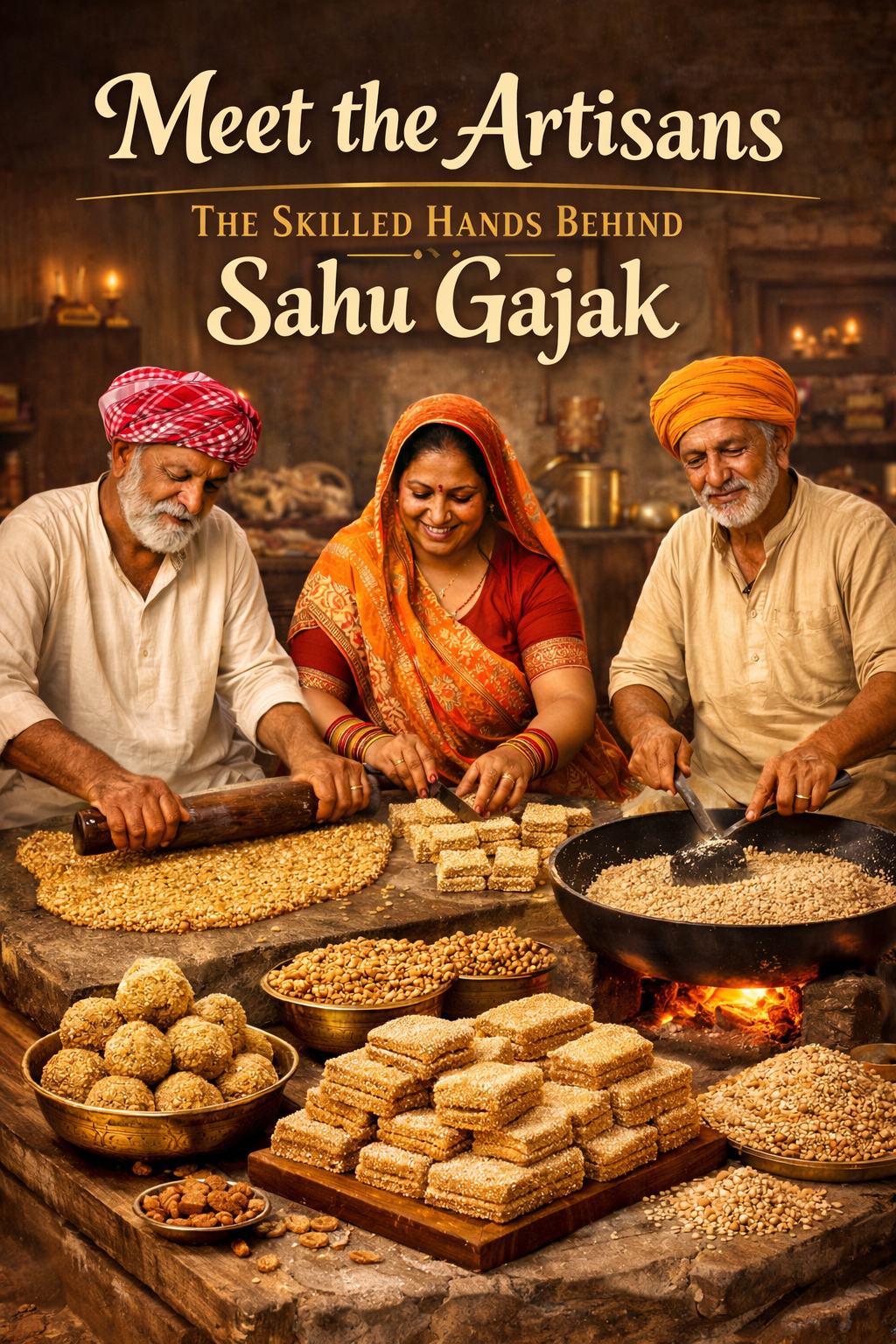
The defining step in Gajak production is repeated hand-hammering. After roasted sesame is combined with hot jaggery-sugar syrup, the mixture is worked by skilled artisans using wooden mallets for 10 to 15 hours. Each hammering cycle stretches the sesame-jaggery mass and folds it back on itself, gradually developing thin layered sheets of sesame visible in the finished product.
This process cannot be adequately replicated by machine. Machine-produced Gajak is made in minutes but lacks the characteristic layered structure and tends to have a denser, more uniform — and less interesting — texture.
What are the different types of Gajak?
Gajak comes in several distinct forms, each with its own shape, texture, and ingredient variation:
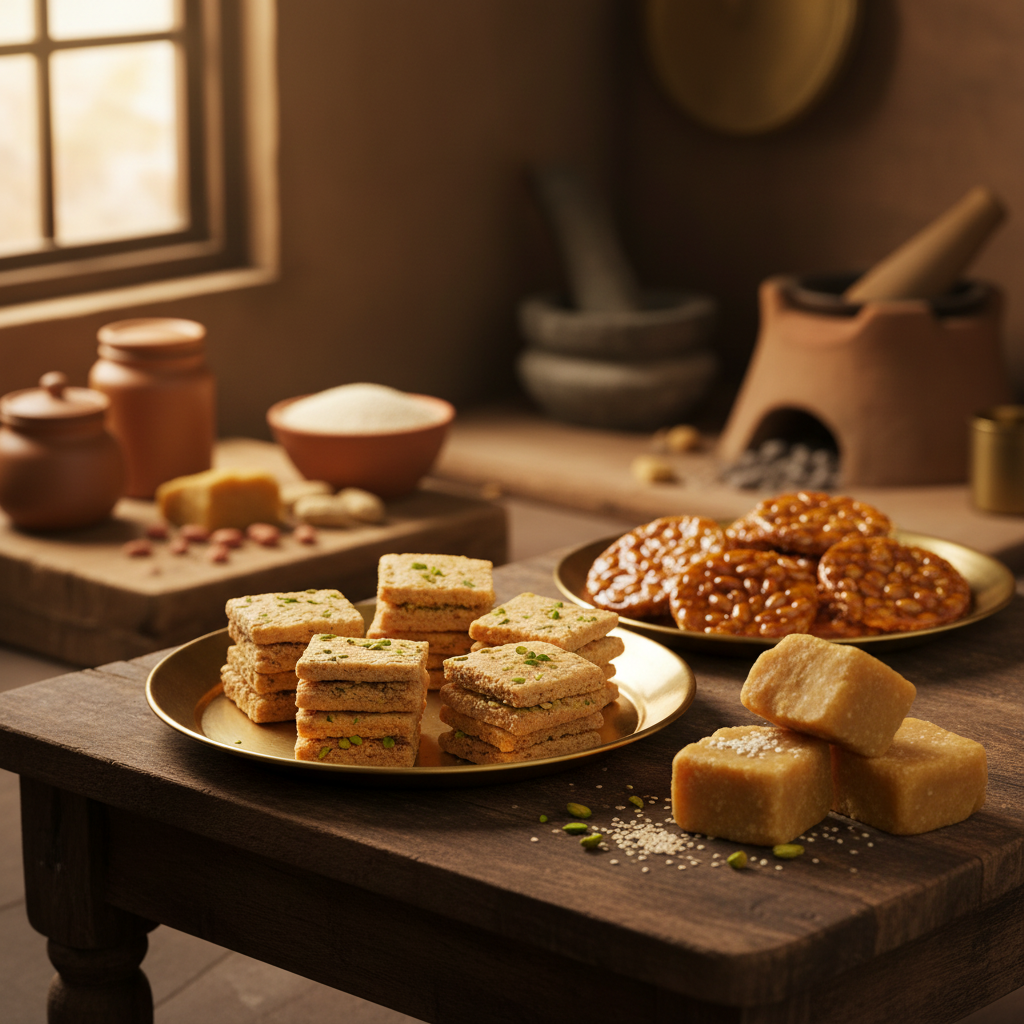
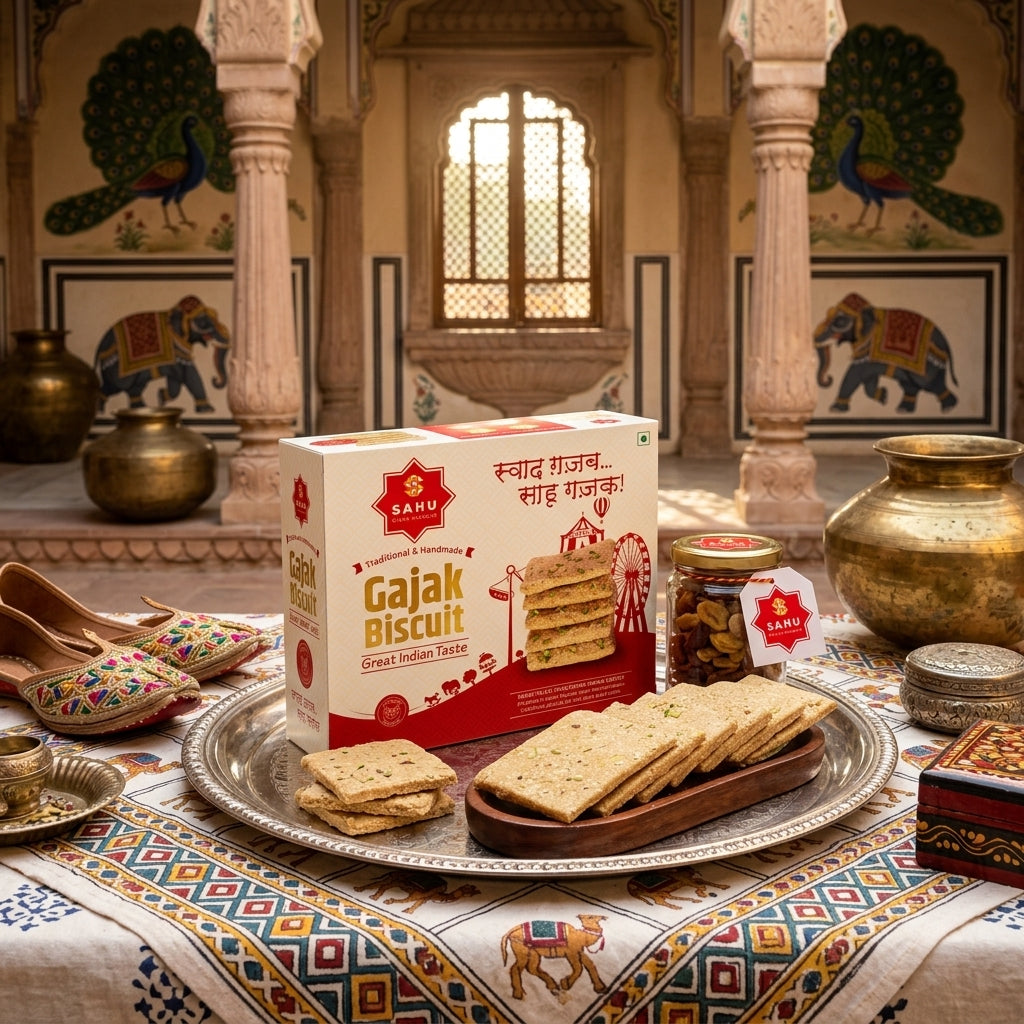
- Gajak Biscuit — the most common form. Flat, rectangular or square biscuit-shaped pieces of crispy sesame-jaggery Gajak. The standard against which most Gajak is judged.
- Gajak Roll — the same sesame-jaggery mixture rolled into a cylindrical log and sliced. Compact and portable, popular for gifting.
- Khastha Gajak — extra-crispy Gajak hammered thinner than standard Gajak, with a more pronounced flaky, shattery texture. Khastha means crispy in Hindi.
- Gajak Barfi — a softer, denser barfi-style version of Gajak, set into a thick slab. Includes dry fruits and has a chewier texture than standard Gajak.
- Dry Fruit Gajak (Rajsi Gajak) — premium Gajak with whole almonds, cashews, and pistachios folded in. The most gifted variety for festivals.
- Sugar Gajak — Gajak made primarily with sugar rather than jaggery. Lighter colour, milder sweetness, less earthy flavour than jaggery Gajak.
- Tilkut — technically a cousin of Gajak rather than a variety. Uses the same ingredients but is pounded rather than hammered, producing a crumblier, softer texture. Closely associated with Sawai Madhopur and Bihar.
What does Gajak taste like?
Authentic Gajak has a complex flavour built on three elements: the nutty, slightly bitter depth of roasted sesame, the earthy caramel sweetness of jaggery, and the richness of cow ghee. The texture is hard and snappy with a satisfying crunch, dissolving into a rich sesame flavour as it melts. The flakiness — layers of sesame visible when a piece is broken — is a marker of quality in handmade Gajak.
Sugar Gajak tastes lighter and milder than jaggery Gajak. Dry Fruit Gajak adds the richness of nuts to the sesame-jaggery base.
Why is Gajak associated with Makar Sankranti and Lohri?
Sesame and jaggery are traditional winter harvest crops in North India. Their combination in sweets like Gajak has become culturally embedded in Makar Sankranti (14 January) and Lohri (13 January) — the two major North Indian harvest festivals of January. Exchanging Gajak, Tilkut, Revdi, and Chikki at these festivals is a long-standing custom across Rajasthan, Madhya Pradesh, Punjab, Haryana, and UP. (Cultural information, not medical advice.)
How do you identify authentic handmade Gajak?
Several characteristics distinguish authentic handmade Gajak from machine-produced alternatives:
- Layered cross-section — break a piece and look for visible thin layers of sesame. Machine Gajak tends to be uniformly dense without distinct layers.
- Ingredients list — authentic Gajak should list sesame, jaggery, sugar, and ghee. The presence of liquid glucose, glucose syrup, or hydrogenated fat indicates a commercial product.
- Texture — authentic Gajak snaps cleanly and dissolves progressively. Machine Gajak often has a harder, more monolithic texture.
- Colour — jaggery Gajak should be a warm amber-brown, not bright or uniform. Very pale Gajak typically indicates a higher sugar-to-jaggery ratio or the presence of glucose.
How should Gajak be stored?
Gajak should be stored in an airtight container in a cool, dry place away from moisture and direct sunlight. Moisture is the main enemy — even brief exposure to humid air will cause Gajak to soften and lose its crunch. Do not refrigerate. Stored correctly, authentic Gajak stays fresh and crunchy for up to 4 months from the packing date.
Where to buy authentic Rajasthani Gajak online
Sahu Gajak Bhandar has been making traditional Gajak in Menpura, Sawai Madhopur, Rajasthan since the 1870s — six generations of the same family, the same recipe, the same hand-hammering process. All products are made with no preservatives, no liquid glucose, and no artificial colours or flavours, and carry FSSAI licence No. 12219038000139.
Browse our complete Gajak range — Gajak Biscuit, Gajak Roll, Gajak Barfi, Khastha Gajak, and Dry Fruit Gajak — available in multiple sizes, freshly packed and delivered across India. Also available on Amazon, Flipkart, JioMart, BigBasket, Blinkit, and Swiggy Instamart.